
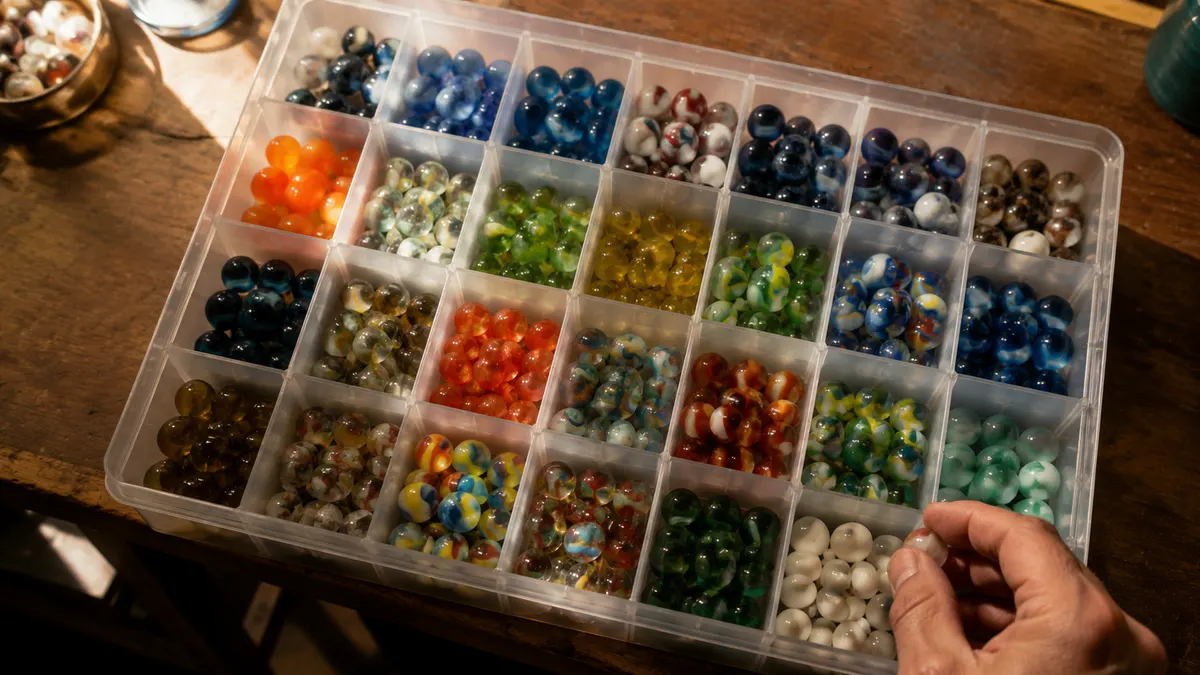
If you collect or sell marbles for more than a year, you end up with a can of trouble. It is the odds-and-ends jar, the coffee tin, the zipper bag that everything you could not decide about went into. Every time you need a specific size or color you dump the whole thing on the bench and sort it by hand all over again, and by the time you are done there is a fresh layer of chips and scratches from marbles sliding against marbles in the bottom of the tin. I know that tin. I have owned three of them.
About a season ago I finally sat down and dealt with mine properly, and the tool that made it stick was not a fancy cabinet or a wall of dividers. It was a plain 34-grid adjustable divider organizer box, the DUOFIRE, chosen mostly because the dividers actually moved and today's price made sense. This is the exact system I used, step by step, so that when you are done every marble has a place and nothing sneaks back into the wrong pile. It is not clever. It is just a box with walls in it, and that is enough once you run it properly.
Step 1: Dump Everything Into One Pile and Frame the Job
Clear your bench completely, lay down a soft cloth with some heft to it, and dump every loose marble you own onto it. Use a folded bath towel or a piece of felt, not a bare tabletop. Glass on a hard surface rolls, and a single marble that picks up speed across a workbench is how you get the first ding of the year. I learn this from experience at least twice a season.
Now sort the pile by rough size into three loose groups: shooters, standard, and mini. You are not being precise yet, just separating the big from the middle from the tiny so that later each group fits its own grid sizes. Larger marbles need the bigger compartments or they will wedge and strain the dividers. Small ones rattle around and slip under the joints, and a marble that slips under a divider is a marble you will not find until you empty the box.
Have the divider box and a roll of masking tape next to you before you start. The box is a flat clear tray with removable dividers, and the tape marks each compartment with what belongs in it. Tape first means you never have to guess at the end of the day what the dark blues in the third row were supposed to be. It also keeps the sort honest if a visitor drifts over to the workbench and starts admiring the pretty ones, which happens here a few times a year.
The 34-grid divider box is the bench tool that keeps a marble stash sorted in one pass
Clear sides, removable dividers, and 34 compartments that hold a whole mixed tin without everything sliding back together.
Amazon Check Today's Price on Amazon →Once the pile is staged into three size groups, you can see the job for what it is. Most of us only have two or three hundred marbles loose at any time, and that is a forty-five minute job, not a weekend. The whole thing feels overwhelming only because it is shapeless. Dividing it by size first gives it shape, and shape is what makes the rest of this go quickly instead of grinding on.
Step 2: Set the Dividers to Match the Largest Marble in Each Row
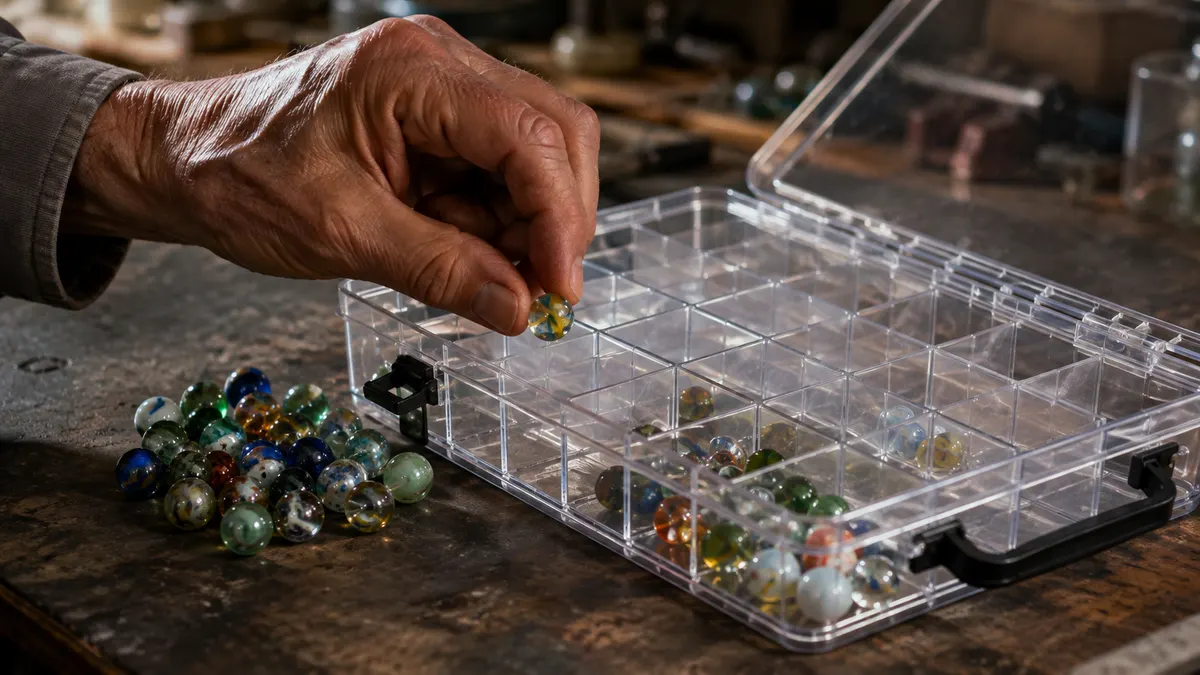
In the DUOFIRE the dividers slide and lock into a grid of slots, so you are not stuck with a set layout. Take your biggest shooter from the pile and place it in the corner of a compartment, then slide the dividers until it has a snug but not squeezing fit. Marbles that rattle are marbles that chip. Marbles that wedge are marbles that crack the plastic over time. You want the middle ground where a marble tips out of your hand cleanly if you dump the cell.
I lay mine out with four bigger compartments across the top for shooters, a band of standard square compartments in the middle for the everyday run, and tight small grids along the bottom for minis. That three-row plan is the one that lasted my whole season without me rearranging it. The adjustability matters here. A fixed egg-crate box would force your smallest marbles to share oversized cells, and then they wander off into their neighbor's color and you are right back to guessing.
Press each divider down until it seats firmly. The plastic has a little give and the lock catches with a faint click. You want that click. A divider that half-seats will pop out the first time you tilt the box moving it across the shop, and your two weeks of sorting empties itself in five seconds. Check every joint before you put a single marble in; it takes sixty seconds and saves a very bad afternoon.
Step 3: Sort the Main Run by Color, Largest to Smallest
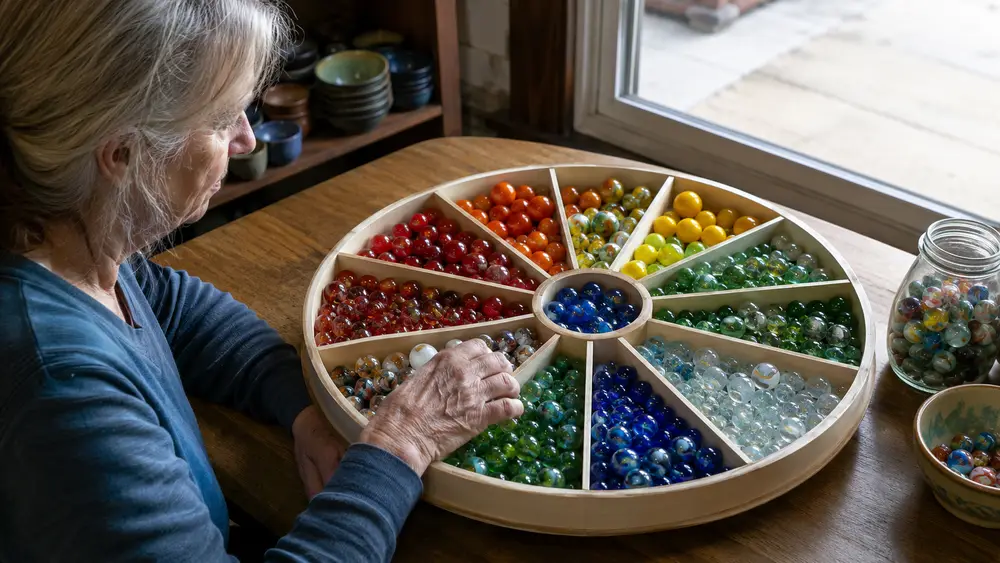
Now the real sorting. Work the standard-size group first and put each marble only after you have eyes on it. This is the part people rush, and rushing is exactly how a rare piece ends up buried under forty of its duller cousins. Hold it up to the window light. You are not grading yet, just reading the color and the overall condition in the same glance. The light tells you more about a marble than your hand ever will, which is why I always sort near a window and not under the bench lamp.
Follow a fixed order so you always know where the next marble goes: I do reds, then orange, then clear and white, then blues, then greens, then the oddballs like swirls and cats-eyes that do not fit a single color at all. It is the same palette order an old marble dealer I learned from used, and it makes the rows read like a color wheel when you open the lid. Strangers who know nothing about marbles will stop and look at a tray that is sorted by color, and that has started more than one conversation that ended in a sale.
Within each color, pack largest to smallest toward the front of the compartment. That way when you reach in for a piece you take the biggest, most valuable ones without tipping the whole cell over. Every time I skip this order out of laziness, the shop loses a marble to the floor, and I have learned to stop skipping it. Two minutes of order beats twenty minutes of crawling around on your knees.
Step 4: Set Aside Everything Chipped or Damaged Into a Separate Tray
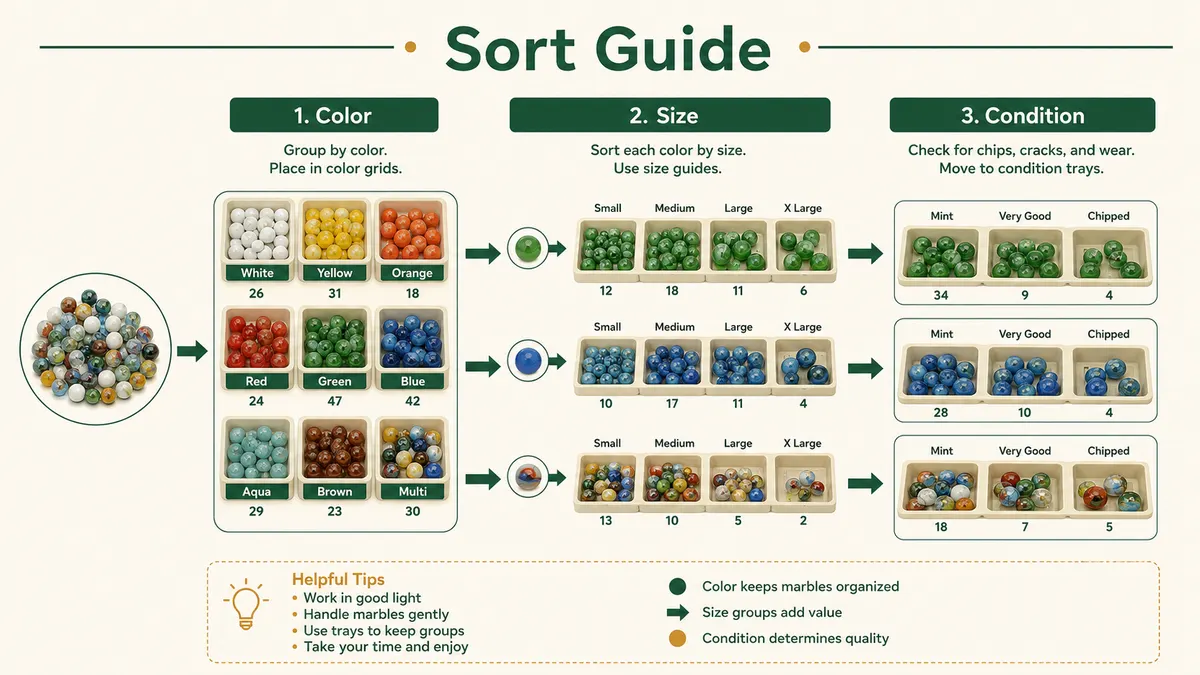
While you sort, any marble with a chip, a crack, a polished-flat spot, or a nasty surface scuff goes straight into a separate small tray, not into the box. Do not put damaged goods against good goods. Glass rubbing against a chipped edge is how a minor flaw spreads into a crack, and a cracked marble in a box of intact ones risks the whole lot. This is the rule I break least, because nobody wants to be the one who ruined forty good marbles to keep one bad one company.
You would be surprised what hides in that odds-and-ends tin: a chipped shooter that was probably clearancing a crack, a vase marble with a flea-bite on the pontil, a handful of speckled things that never quite made it. Pulling them out of circulation is most of the job. What is left in the box after this pass is stuff you would not be embarrassed to sell or to display, and that is the whole difference between a stash and a collection.
The damaged tray is not garbage. I move mine to a labeled coffee tin for sellers who buy lots for craft or for the grind-up trade, and it has paid for the divider box many times over at the summer flea markets. One blocker's trash pile is another buyer's craft material, so do not throw any of it away until you have shown it to the kind of person who makes things.
Step 5: Label Every Compartment and Seat the Lid
Take small pieces of masking tape, write the color and rough size on each one, and stick it to the lid over its compartment before you close it. Do the labeling now, in the momentum of the sort, because in three weeks you will not remember whether the blues ran large to small or small to large. Trust me on this. The tape costs nothing and it is what makes the box actually usable at arm's length.
When you seat the lid, give the box a small deliberate tilt one way then the other on the bench so you can see how much the marbles shift in their cells. A little movement is fine. A lot means the compartment is too big and you should adjust the divider. Get it right now, before the box lives stacked with other inventory, because chasing a loose marble through a full carton is a special kind of annoying.
Then put the box on a shelf where it is not in a traffic path, and keep it out of direct afternoon sun. It is clear plastic, so if a compartment ever looks wrong at a glance you can catch it without opening the lid. The whole point of the system is that a glance is enough. You should finish this step able to find any marble you own in under twenty seconds, and that is a genuinely good place to be.
What Else Helps
A couple of small things make this system stick. Keep a second smaller divider box or a few empty tin cans on the bench for the damaged lot so it never has to share workspace with the sorted box. Keep a clean soft cloth within arm's reach and wipe a marble with your thumb before you let it into its cell; a dusty marble drags grit against its neighbors and dulls their polish over a few thousand touches.
Keep a small notebook with a running count of what you hold by color and size. If you sell at all, that count is your stock sheet, and it keeps you honest about what you actually own instead of what you imagine you own. This is also the moment I check the light in the room where the box lives, because prolonged direct sun on clear-sided storage is a slow way to yellow a good piece of plastic and fade an already sun-touched color.
The moment a marble has a home, it stops being loose inventory and starts being a collection you can actually find things in.
The divider box is not the only storage answer, and it is not trying to be. If you mostly display rather than deal, you will still want your best pieces on stands or in a cabinet where the light can reach them, and a few originals in a quality tin. But every serious stash keeps a working bench box, the one you can open fast, sort into, and draft from when you are selling or matching a set. That is what this DUOFIRE is for me, and it has outlasted the novelty of every cheaper organizer I tried before it.
It is roughly thirty-four compartments in a clear tray you can see through and rearrange, for less than you would spend on two nice coffee drinks. I have owned mine a full marble season and it has earned its corner of the bench many times over, especially on the afternoons I come home from an estate sale with thirty marbles I do not yet know. I tip the lid, read a label, and they have a home before the kettle boils.
Give every loose marble a home in one bench session
Set up the 34-grid adjustable divider box in an afternoon and watch the odds-and-ends tin disappear from your workbench for good.
Amazon Check Today's Price on Amazon →