

If you collect and you sell, you know the loose-tote habit. You pour the day's buy into a tub so you can move on, telling yourself you will sort it when you have an afternoon. Only that afternoon never quite comes, so the tote sits under the bench and every hunt starts by sticking your hand in and feeling around in the dark for a color that may not even be there.
I ran that way for years with Ruth in our shop, and I have more chipped seams and one uneven complexion pairing to show for it than I like to admit. So when the tote finally overflowed and I set up a proper grid, I wanted to know what was genuinely better and what was just tidiness theater. Here is the honest split between the DUOFIRE 34-grid divided box I now keep on the bench and the loose container it replaced, from a shop that handles a bulk buy every couple of weeks.
| Divided Organizer Box | Loose Box of Marbles | |
|---|---|---|
| Price today | A modest one-time cost, no assembly | A cheap plastic bin you may already own, or free if you scrounge one |
| What it holds | 34 grids at roughly a honey spoon each when set to medium, a few hundred total | Whatever you pour in, several hundred loose pieces at once |
| Sorting | Keeps color and size apart on its own once you set it | You re-sort every time you want a specific piece |
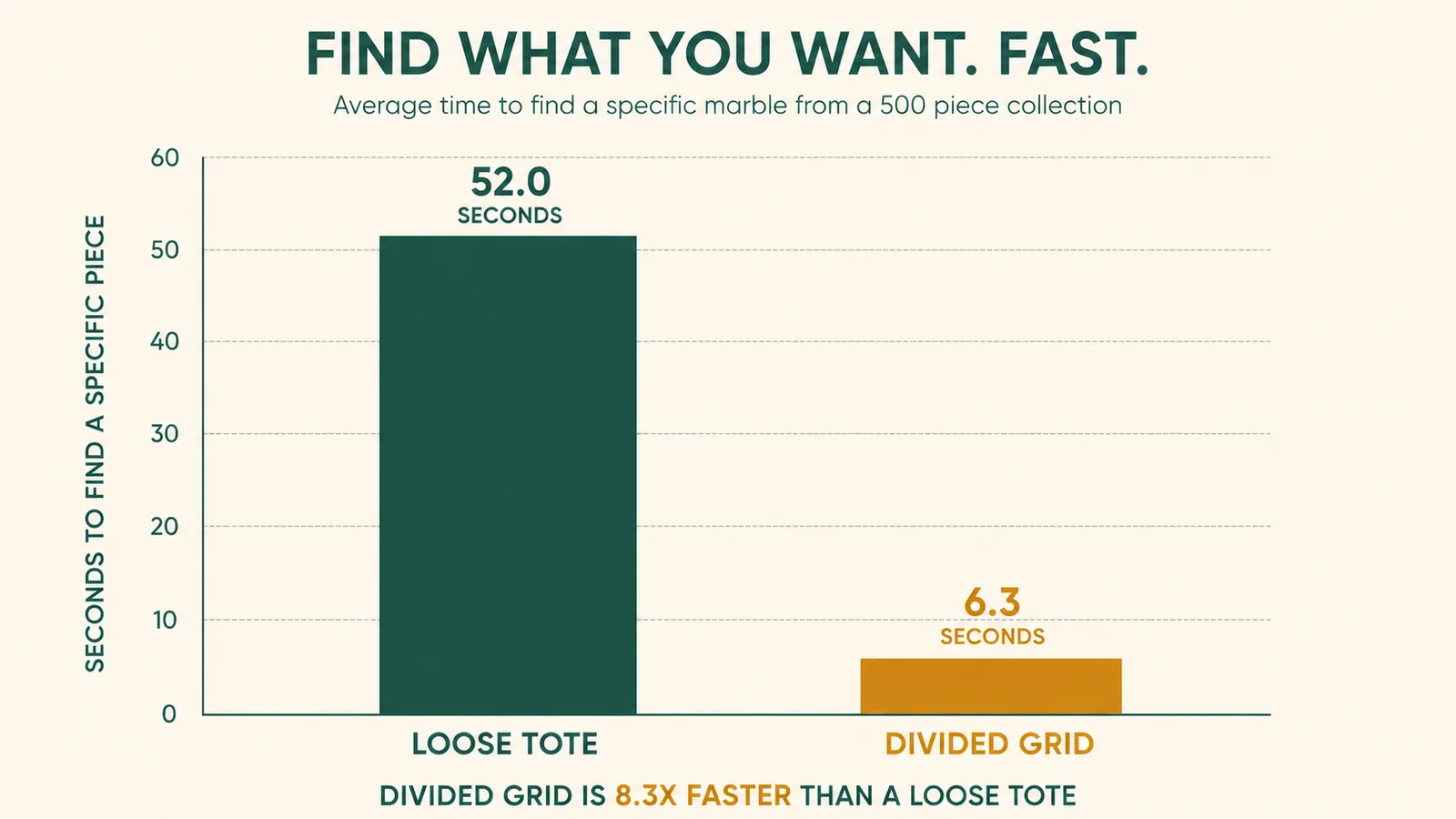
| Finding a piece | Lift it out without touching its neighbors | Dump, dig, and hope |
| Wear on the glass | Cushioned, low motion between pieces | Pieces roll and knock against each other |
| Moving or transporting | Lid seals, but light grids shift if jostled hard | A lidded tote travels loose and noisy |
| Selling from it | Grab a clean compartment straight into a lot | Dump a handful onto the scale and recount |
| Bulk buy staging | Slows you down before you know your groupings | Holds the undecided pile while you make up your mind |
| Warranty | Amazon-backed return | None on a plain bin |
Read the table the way I do: the grid wins every row you touch twice a day, and the tote wins the rows that come once a season. That is the real trade. A divided box costs you a little floor space and a few dollars at today's price, and in return it buys back the two things you cannot replace, your time at the bench and the untarnished seam on a piece you mean to sell. Everything below follows from that one trade.
A word on how I approached the test, so you can trust the verdict. I ran both for a full season side by side, filling the grid with a couple of hundred pieces and leaving the rest to the tote, and I kept notes on where each one actually slowed me down. That is longer than either tool strictly needed to show its nature, but a fair comparison deserves a season, not a single afternoon and a snapshot.
Where the Divided Box Wins
The whole case for the grid comes down to one thing: you stop touching glass you are not buying or selling. Put plainly, when I sorted the old tote I picked up every piece at least twice, once to look at it and again to put it back, and every pickup is a chance to roll two marbles against each other hard enough to put a fleck on a seam. A seam fleck does not end the world. But on a piece you mean to offer at a premium, it shaves a bit off the asking price, and you never get it back once glass has kissed glass.
The DUOFIRE box changed that because each compartment holds one grouping and stays put. I fill a grid with the dark oxbloods, the next with the cat's eyes, the third with the small commies I only ever sell by the count. When a customer asks for a dozen oxbloods, I tip a compartment onto the scale rather than pawing through half a tub to hunt a color. For a small dealer that alone is worth it, because my time is the scarcest thing in the shop and the scale, not the haggling, is where the day goes.
The adjustable dividers matter more than the count of grids on the box. I do not keep thirty-four equal rows. I pull a divider out to give the big shooters a wider home, crush four little grids into one for the half-inch commies, and leave a single slot free for the odd piece I have not classified yet. That ability to shape the box to your own grouping, instead of being forced into someone else's mold, is what separates it from a fixed egg-crate insert.
And there is the looking-at-it benefit that is easy to underrate. With a clear lid and rows of sorted glass, the collection reads at a glance. Visitors stop and look, which in a shop is not vanity, it is the thing that turns a browser into a buyer. A clear grid is the closest thing to a display case that still stores for the long term, and for a shop with limited wall space that is a real overlap it earns honestly.
One practical note on light and handling while the box is on the bench: because the compartments keep pieces from touching, you can run a soft cloth through a grid without chasing a rolling marble, and you can pull one piece without disturbing the rest of the color run. It does not replace careful hands, but it gives careful hands something better to work with than a wobbling pile.
The grid that keeps your good glass from rolling together
This DUOFIRE 34-grid divider box is the one I put on my bench after the tote taught me the hard way. Adjustable dividers let you size compartments to your own grouping, and the clear lid shows what you have at a glance.
Amazon Check Today's Price on Amazon →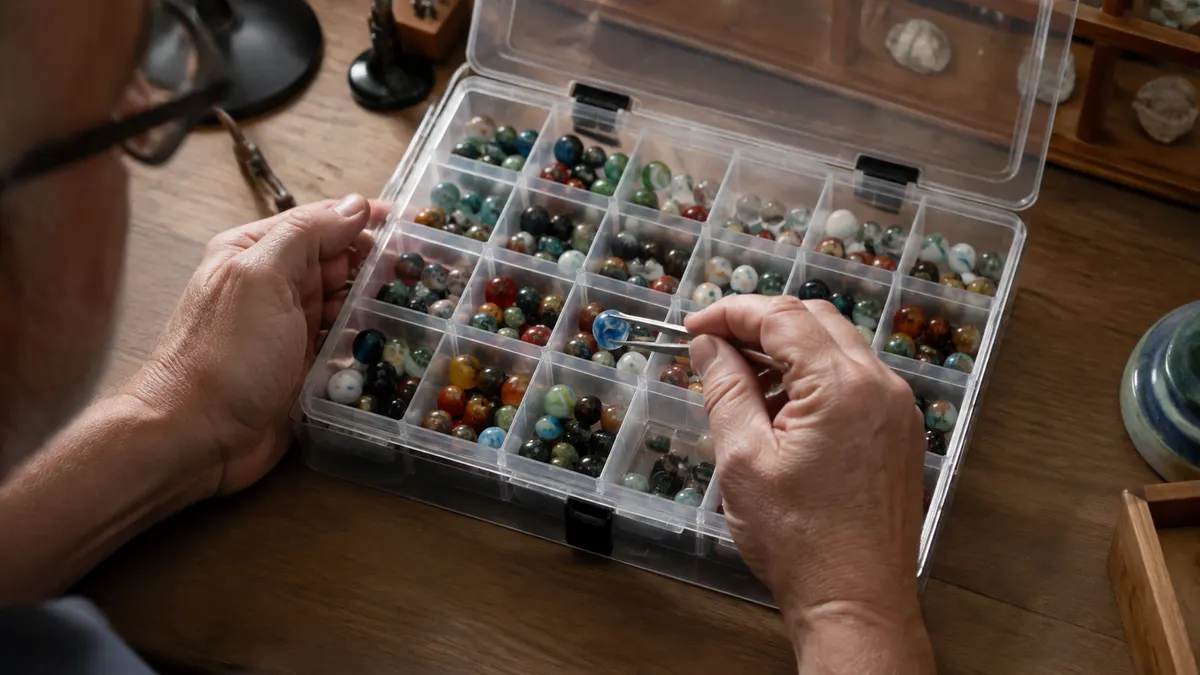
Where the Loose Tote Wins
I am not going to pretend the tote has no place, because it does, and its place is bigger than most of us admit. If you do not sort at all, if you just enjoy running your hand through a tray of glass and buying in bulk for the joy of the pile, a tote is the honest answer. It holds hundreds of pieces for very little, it seals against dust, it takes a knock, and nothing about it demands you be tidy on anyone's schedule but your own.
The other place the tote wins is the early stage of a buy. When you bring home a mixed bag of a few hundred pieces and you have not decided your own groupings yet, a divided box just slows you down. Every compartment you set is a guess about how you will sell, and the first time you change your mind you are back to pouring it all out. A tote lets the collection stay undecided until you actually know what you sort by, color, size, maker, or condition. Ruth and I kept a tote of unexamined buys going for months on purpose, and I would rather have had a bigger one than a grid in that season.
The tote is also just easier on volume. A grid caps you at what its compartments will hold, and overfilling one grid spills into the next and undoes the whole point. For a stash measured in the thousands, or for bulk that is only ever going to be sold as one low lot, a tote is the lower-effort answer and nobody benefits from pretending otherwise.
Whose Gear, and Whose Season, It Fits
I have come to think of it as two tools for two seasons rather than one winner. In a slow season, when nothing is moving and I am not buying, the tote is fine because nothing needs finding beyond the pieces already out on the rack. In a busy season, when lots are coming through the door and a customer wants a specific matched pair this afternoon, the DUOFIRE grid earns its keep a dozen times a day. The leanest dealers I know switch between the two on purpose rather than swearing loyalty to either one.
That is the honest place most of us land: one grid for the good, sorted stock and a tote for the buy-and-sell churn. If you buy the box expecting it to replace the tote entirely, you will be disappointed the first time a big unexamined haul comes in and you are not sure how you want to split it. If you use each for the job it is actually good at, you stop fighting your own bench and start moving stock, and that is the whole point of either one.
There is no shame in the tote, and that is the part the tidy-grid photos never tell you. Every dealer I respect keeps one around. The question was never which is a better object, it is which one you reach for on a given Tuesday, and the answer changes with what is in the crate that week. Own both, know which does what, and you win no matter which side of the comparison you are leaning toward this month.

Who Should Buy Which
If you keep your collection sorted and you sell pieces by the handful, or you value knowing exactly what sits where so you never dig for a color, the divided box is the better buy. It pays for itself the first time you answer a customer's question without turning the shop upside down. It is also the right call if you mind your glass, because fewer touches means fewer flecks on seams you intend to sell.
If you are new, if you still buy by the bag, or if a tidy grid would only make you anxious about disturbing someone else's order, save the money and use a tote until your collection tells you it wants separation. There is no virtue in a compartment you resent. The box earns itself best once you already know what you separate and why.
Most serious collectors and dealers end up somewhere in the middle, one grid for the good stuff and a tote for the buy-and-sell churn. That is a fine way to live, and it is the way I recommend you start. Buy the box when the bench starts to feel cramped and the digging starts to feel wasteful, and keep a tote around for the pile you have not decided on yet.
The difference I see every week is what happens when somebody knocks a tote over. In a loose bin the whole lot goes, every piece that was resting against its neighbor now rolling free, and you spend the next hour wondering which of the scratched ones used to be the good one. The divider box does not stop the topple, but it stops the worst of the damage, because each cell holds only a handful and the pieces sit in little cradles instead of a pile a foot deep. It changes a catastrophe into a nuisance.
There is a real argument for the tote though, for the collector who only owns a shelf full of commons and has no need to keep ten categories separate. A single big box is cheaper, lighter, and fine for bulk. The divider earns its place the moment you have two grades going, or you trade, or you want to walk a customer to exactly the category they asked for without pawing through everything you own. That is the point where running a proper showroom starts, and the box is what makes it feel like a shop instead of a pile of glass.
Started sorting. Now keep it that way.
Once you taste actually finding a marble the first time you reach in, you will not want the tote back. The same 34-grid DUOFIRE box I run my selling stock out of is built to take daily use.
Amazon Check Today's Price on Amazon →