

Here is the thing most marble collecting never tells you up front, and I only learned it after paying for the lesson more than once. A marble that looks perfect at arm's length, glossy, round, almost too clean, can be hiding a chip on its rim, a rough seam right where the two halves of the cane pressed together, or a hairline crack running through the middle that your eye simply skips. You cannot grade what you cannot see, and you cannot see it with the naked eye resting across the table.
I buy and sell marbles and glassware out of a small shop in central Ohio, and I have sat across the table from plenty of folks certain they held a mint piece who handed it over, under good light, holding a broken one. I have been the one holding the broken one too, more than once. A decent JARLINK 30x illuminated jeweler's loupe ends most of that guessing. This is the exact method I use, step by step, so the next piece you pick up gets judged honestly the first time.
Step 1: Get Even, Low Light Before the Loupe Ever Comes Out
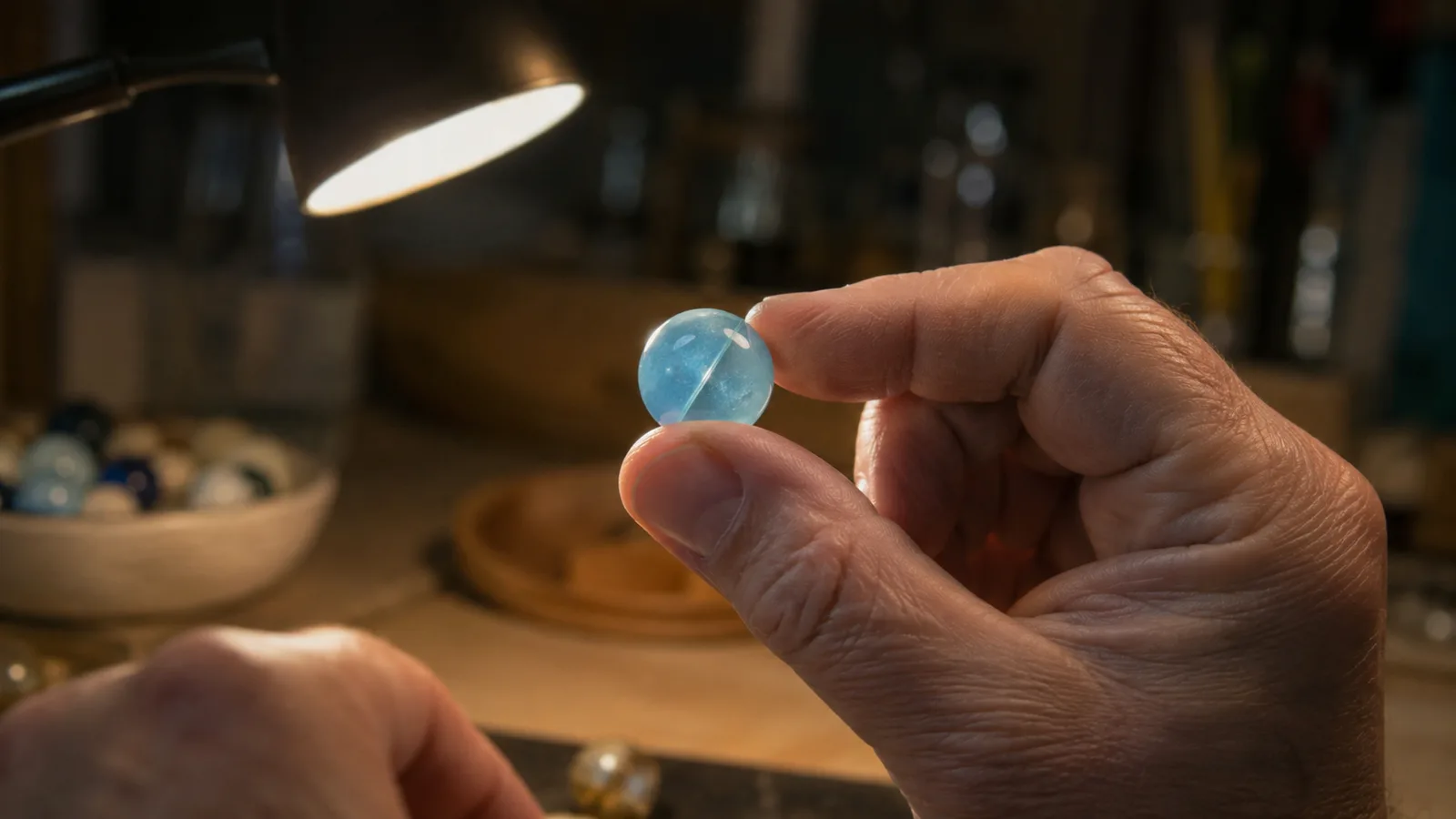
Set up your light before you touch a marble. The biggest mistake new graders make is reaching straight for the loupe under a harsh overhead fixture, because a hard overhead bulb throws a glare that hides flat chips in the very top of the dome and turns a rough seam into a bright blur. You are not grading what you want to see, you are grading what the light lets through.
Sit beside a window on an overcast day if you can, or use a small lamp set low and off to one side so the beam rakes across the marble rather than straight down on it. Raking light is the key. It catches the lip of a chip as a tiny shadow line and exposes a seam that straight-on light flattens away. A plain white tube or a daylight LED works; what matters is that it is even and at an angle, not dead overhead.
Lay down a felt or a folded towel first. Glass on a bare table rolls, and a marble that picks up speed across a workbench is the fastest way to kill a piece you were about to price. I have lost three good ones that way and I do not grade anywhere without a soft cloth under the working hand anymore. It costs nothing and it keeps the worst accident of the whole trade from happening in the first minute.
The 30x/60x illuminated loupe that puts a pinhead chip in plain sight
This JARLINK foldable dual-power jeweler's loupe with a bright LED ring is sized to slide in a shirt pocket and read a marble up close the honest way.
Amazon Check Today's Price on Amazon →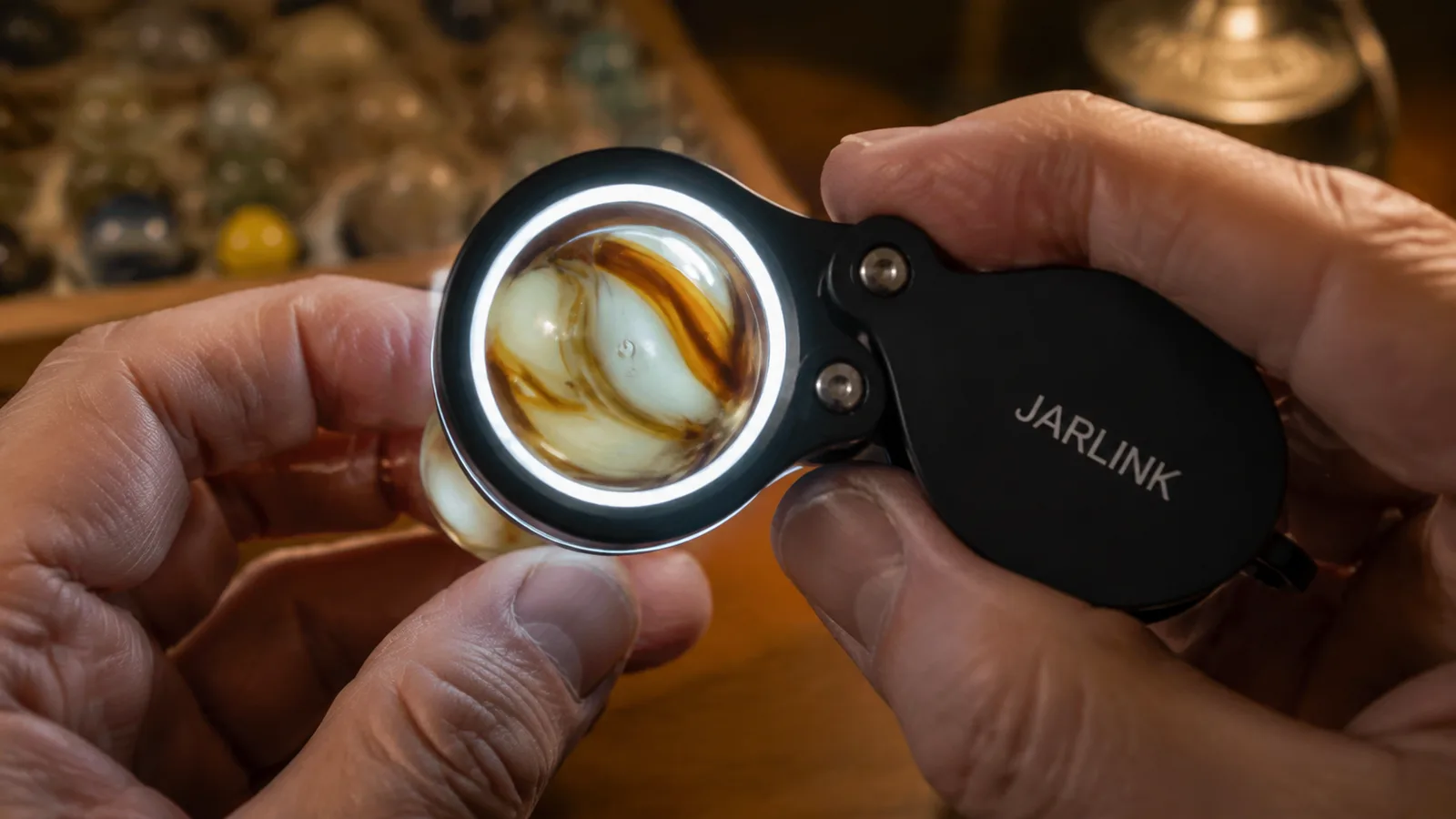
Step 2: Brace the Loupe Against Your Eye Socket, Not in the Air
The correct way to hold a jeweler's loupe is the way the name suggests a jeweler does it, wedged between the brow and cheekbone so it is locked to your eye, not floating in your shaking hand. Open the loupe, press it into your eye socket, and bring the marble up to it, not the other way around. If you hold the loupe out in front of your face, the tremor in your hand shakes the whole field and you will swear every marble has a wiggle in it.
The loupe I use is the JARLINK, a small foldable one with a 30x side and a 60x side and a little LED ring in it, and the LED is what makes it usable in the dim corner of a shop or a crowded flea market aisle. At 30x you see the surface finish of the glass, and at 60x you can read the interior. Keep the working side clean; a smudge on the lens and a smudge on the marble are two different things, and a fingerprint will cost you a wrong call on a mint piece.
Step 3: Read the Surface for Chips and Rough Patches First
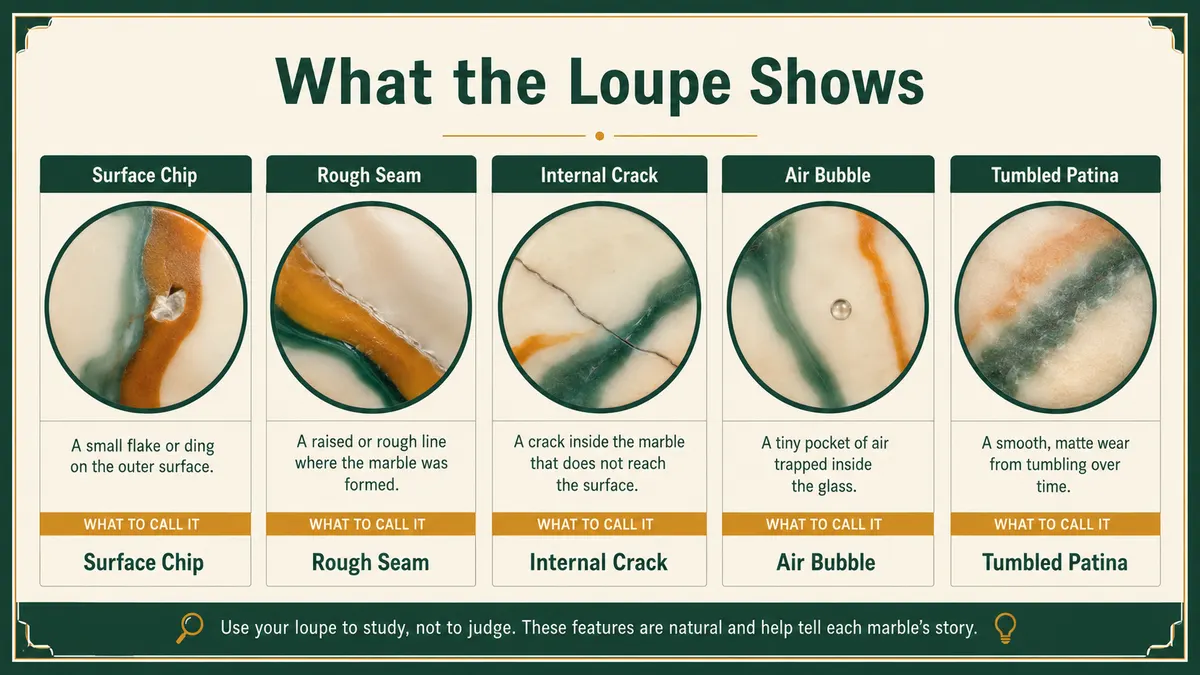
Start at 30x and sweep the surface with the light low. Work around the whole dome in a slow circle, because the flaw always hides in the spot your eye settles on last, which is why a marble can look flawless in a five-second glance and sit four inches from a chip of the worst kind. A chip reads as a small rough notch with a shadow at its lip. A rough patch, what dealers sometimes call a sand pit, reads as a dull mottled area that breaks the glossy skin.
This is also where you spot the tumbled ones. A marble that has spent thirty years in a child's pocket or the bottom of a tin has a fine ground-down flatness instead of a crisp round skin, often most visible as a soft sheen at the very crown. Tumbled marble is not broken, but it is not mint, and if you are selling you need to know which story you are telling. The loupe settles in three seconds what your hand and your hopeful eye have been arguing about all afternoon.
Go slow here. I grade with the marble resting in a small ring of my palm so I can rotate it with my thumb without dropping it, and I take my time even though I have graded thousands. Hurrying the surface pass is how a chip sneaks through to the pricing stage. Take it as a point of pride that nothing you sell carries a hidden flaw you could have caught, and nothing you buy has one you missed until you get it home and the light changes.
Step 4: Find and Read the Seam, the Place Two Halves Pressed Together
Every handmade or machine-pressed marble has a seam where the two halves of the mold or the cane joined, usually running around the equator of the sphere. You are not automatically penalizing a visible seam; some makers pressed a proud seam you can feel with a fingernail and it is just the character of that piece and that maker. What the loupe is for is deciding how clean and even that seam is, because that is most of the difference between a working piece and a collectible one.
At 30x, look for where the seam turns rough or has a fleck chipped out of it. A clean seam reads as a thin even line that catches light exactly the same all the way around. A bad one reads as a jagged or lipped ridge, sometimes with a tiny crescent chip right at the crown where a hard knock landed. That crescent at the seam is the single most common damage I see on otherwise nice marbles, and it is almost invisible without magnification.
Run your thumb across the seam too, but only after the loupe has told you what it looks like. Your thumbnail will feel a proud seam your eye calls clean, and that is a real and honest way to grade. Loupe for the flaw, fingertip for the feel, and let the two of them agree before you put a grade to the piece. When they disagree, the roughness usually tells the truth, and the loupe wins.
Step 5: Take the 60x Side Inside for Cracks and Bubbles Last
Once the surface and the seam are read, flip to the 60x side and look through the glass at the interior. This is where a hidden crack finally comes out. A clean interior should be smooth, down to the faint swirl of color that a vintage cane marble pulls through it. A crack reads as a thin bright line or a small feather of fractures catching the LED; an internal crack is the deal-breaker flaw because it can open up at any point under temperature change or a hard knock.
Bubbles are a trickier call. A few tiny rounded bubbles are normal in older handmade glass and are not damage at all; some collectors actually prize them as a sign of age and handwork. What you are flagging at 60x is a big, elongated, or clustered bubble, or a bubble sitting right up against the surface skin, because surface-adjacent bubbles are where a marble is thinnest and most likely to chip. Round and few is fine. Big and at the skin is a caution flag.
End your pass the same way every time, with the 60x lens searching the very middle and the crown. Read the surface, read the seam, read the interior, and do it in that order on every piece, every time. The repetition is the whole trick. A grade you can stand behind comes from doing the same three passes until they are habit, not from how sharp your eye is on a lucky afternoon.
One more discipline I grade by even though it costs me the occasional sale, and I do not mind saying it. If the loupe shows me a flaw I would knock the price for, I knock the price for it and I say out loud what the loupe showed. The reason is not honesty on its own; it is that the marble trade is small, and the buyer sitting across the table today is the seller I need to trust next month. A dealer with a good loupe and a straight word moves better glass than one who hopes nobody looks close.
What Else Helps
Keep the loupe in a shirt pocket, not buried in a drawer, so it is there when the interesting table appears. It is small enough to lose for a month, so give it a home on the bench or in a pouch and always put it back. A tiny lens brush or a soft cloth for the working face keeps the reading honest, and a spare button cell or two for the LED means the light never dies mid-sort at a show, because it always dies at the worst possible moment.
I also keep a small notebook within arm's reach and write a grade and a one-word condition next to each piece I am serious about, so the pile that came off a table gets a record instead of a promise I repeat to myself and forget. Grades are for the bench, not for the ego. The point of the whole method is that when you eventually pick up this loupe in front of a buyer, the careful work you did in the dim shop pays off in the bright sunlight.
That chip I almost bought was invisible from a foot away and unmistakable at a quarter inch under a raking light. That distance is the whole argument for the loupe.
The loupe is a small tool and it is not trying to replace a grading table or a jeweler's torch. It does not tell you a marble is worth money, and it cannot read an opaque glass where the interior is hidden. What it does, and does better than any naked eye, is settle the argument about whether a piece is clean before you lay money down on it. For a collector and a dealer both, that one question is worth more than any other tool on the bench.
I have owned this loupe a full season and it has earned its pocket many times over, especially the afternoons I come home from an estate sale with a dozen marbles I do not yet trust. I clear the bench, set the light low, seat the loupe, and run the three passes. Before the kettle finishes, I know which ones stay for the display case and which ones go in the craft bin. That is a genuinely good place to be, and ten minutes and a quarter inch of glass put me there.
Stop buying other people's mistakes and grading yours the hopeful way
Seat the 30x/60x illuminated loupe in your eye socket tonight and run the three passes on the next marble you pick up. The honest read pays for it fast.
Amazon Check Today's Price on Amazon →