
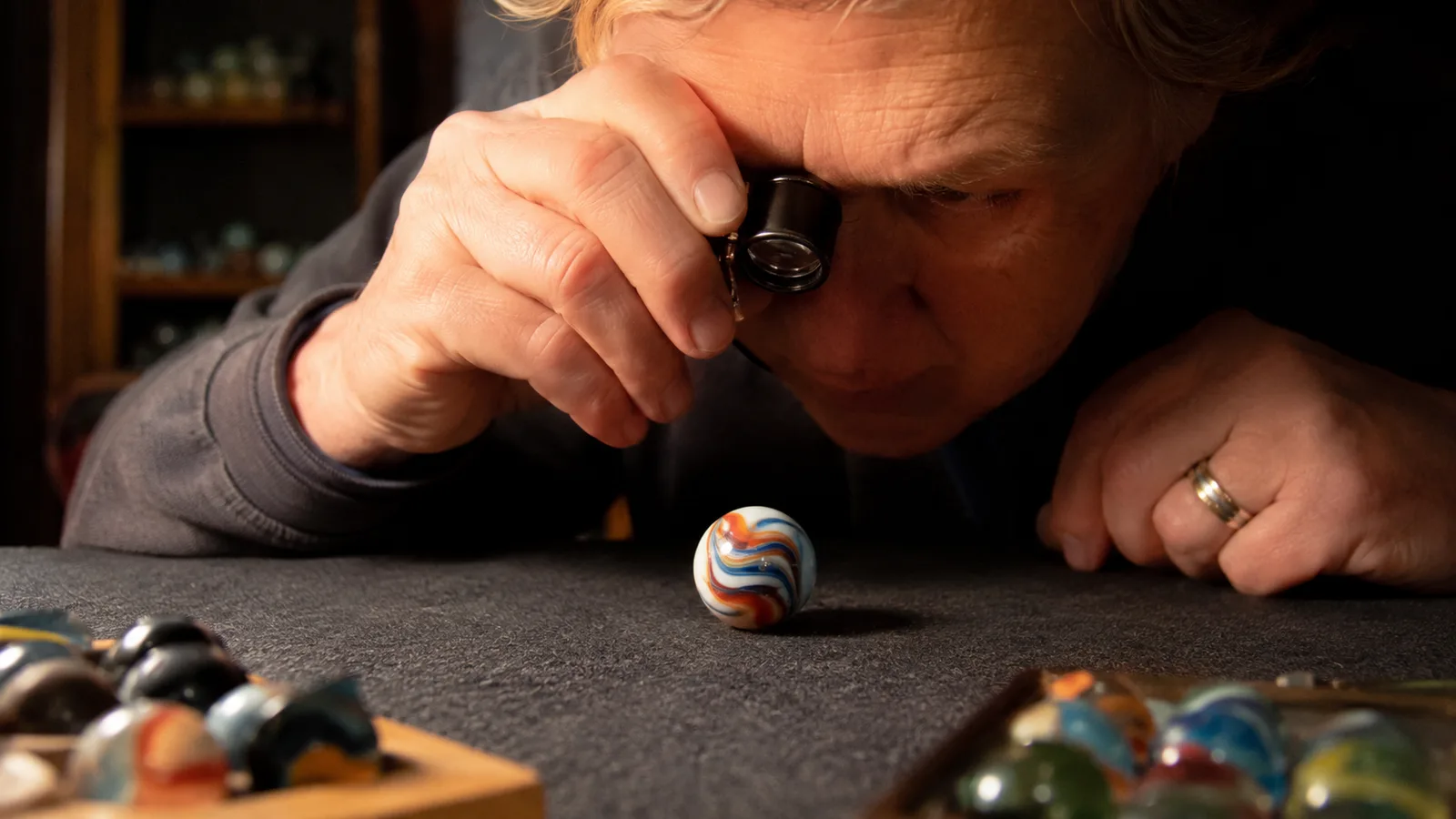
You think you know a marble until you put it under glass and see the chip you paid for anyway. I tell people in the shop that I've met plenty of marbles I trusted at arm's length and later regretted. That is the whole reason I finally stopped relying on my eyes and bought a JARLINK jeweler's loupe. Twelve months on, grading at my bench in central Ohio, it has become the tool I reach for before I say a price out loud.
I'm Lonnie Gentry. Ruth and I have bought and sold vintage marbles, glassware, and small glass for going on twenty years out of our shop, and I still collect for myself. This loupe, the JARLINK 30x 60x with the LED, has sat on the same felt pad since last August. What follows is how it actually behaved for a year, not how it looks in the marketing photos.
The Quick Verdict
A modest loupe that does the one job a collector needs it to do, which is show you the damage before your money is gone. The focus is finicky and the light eats batteries, but for grading and buying it earns its place on the bench.
Amazon Check Today's Price →Stop trusting your eyes on a costly mistake
A tiny chip you cannot see at arm's length is the difference between a keeper and a hard sell. The JARLINK 30x 60x loupe shows it to you before you pay.
Amazon Check Today's Price on Amazon →How I've Used It
I did not read the loupe over lunch and call it a day. I used it every month for a year, mostly on three jobs. Grading the edge of factory marbles for chips and bruises, checking the mold seams and age lines on vintage glassware I mean to buy, and giving a final inspection to anything leaving the shop with a price tag on it. That second one is where a loupe pays for itself, because a seam flaw I catch before I buy is worth more than the loupe cost three times over.
The loupe folds open like a small clam and holds 30x and 60x lenses back to back. You hold it right up to your eye and bring the piece toward it until it snaps into focus, which takes some getting used to. I kept the fold in my shirt pocket most days and reached for it twenty times a week. It weighs nothing, about the size of a fat coin, and the spring hinge on the fold is the first thing that will tell you how cheaply it was made.
I relied most on the 30x side for day to day grading. The 60x is a party trick and a trap, more on that in a minute. I used the built-in LED mostly at flea markets and estate sales where the light is bad, and the daylight side when I could stand at a window. My bench light is good, but a shop corner on a gray Ohio afternoon is not, and the LED has saved me on plenty of dull days.

What the Loupe Actually Catches
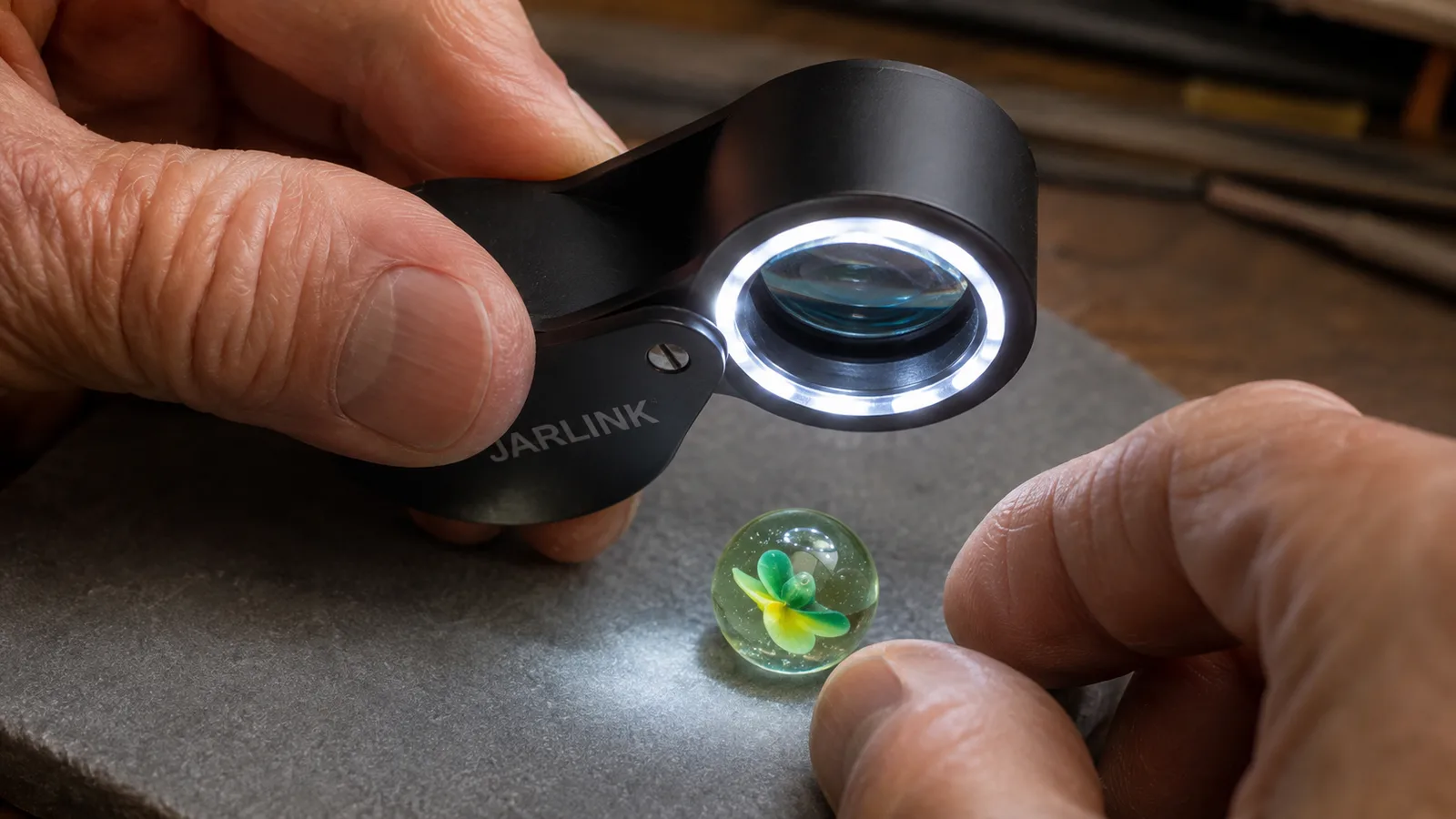
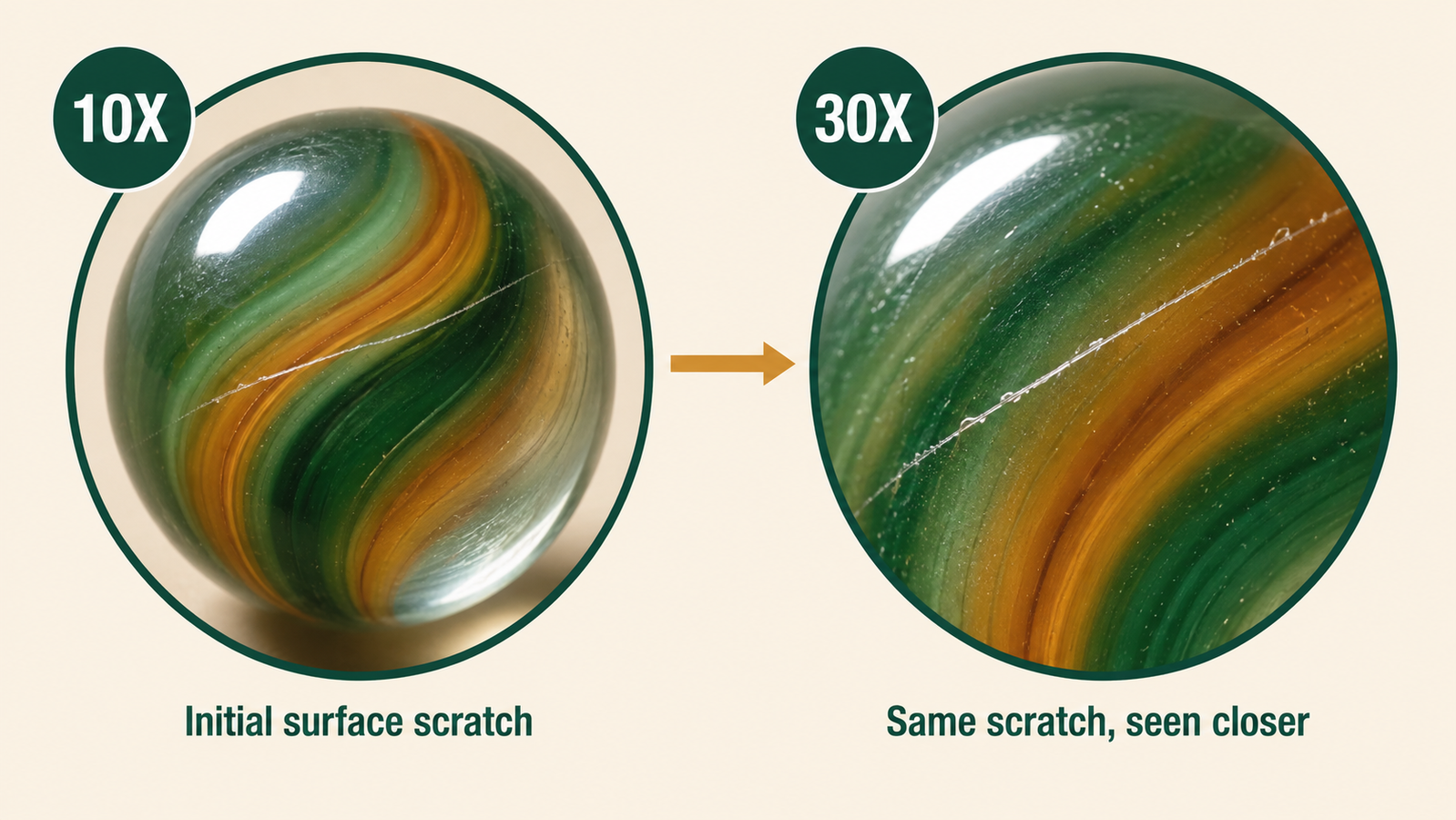
The honest answer is more than your eyes, but less than the ads suggest. At 30x I can read the surface of a marble the way a book dealer reads a spine. A feather of a chip along the equator, the kind that flashes only when the light hits it just right, shows up dead obvious under glass. An old repolish, where a dealer has ground a damaged spot smooth, has a telltale flattening that I can see at 30x and can never see with the naked eye. That alone has kept me from overpaying for steadies that were quietly not as described.
On glassware it is just as useful. I look at the bottom rim where a vase gets worn, the pontil scar on old pressed glass, and the seam lines on the body. A mold seam that runs clean from base to lip usually means a well-made early piece. A seam that waves or doubles over tells you it was made sloppy or has been damaged and filled. I caught a hairline crack running through the base of a piece of Fenton glass last spring that the seller claimed was perfect, and I put it back on the table. The loupe had paid for its year in one afternoon.
The thing people do not warn you about is what the light does. The LED is a single bright ring, and it throws hard shadows that can look like damage when the surface is simply curved. On the first few marbles I graded I flagged ridges that turned out to be highlight lines, not flaws. You learn to angle the piece and let the light skate over it before you call anything a chip. Do not make your first grading decision in the first week you own one.
The 60x Side and the Focus Trap
Here is the part the product page will not tell you. The 60x lens is nearly unusable for day to day grading, because the depth of field is about the thickness of a fingernail. You can focus on the very apex of a marble's surface and nothing else, and the moment you breathe, it goes blurry. It is fine for a static flat surface like a stamp or a coin, and I have used it to read the faint maker marks on the base of some small glassware. But for a round, three dimensional marble it is a frustration, not a tool.
So I live on the 30x side, which has a forgiving focus depth. The catch is the same one every cheap loupe has. There is no focus ring, you focus by moving the whole assembly toward or away from the piece. Once you get the hang of the right working distance, about an inch, it becomes second nature. But a first time buyer will spend ten minutes thinking the loupe is broken before they figure out that it is their distance, not the lens.
The spring hinge on the fold is the other weak spot. After a year of opening and closing it, the fold has loosened to where the two halves do not snap shut cleanly anymore. It is a known limitation of a modest work tool, and it has not stopped the loupe from working. But it tells me this is not a give-to-my-grandson instrument. It is a replaceable work tool, and for what it costs, that is an honest trade.
I caught a hairline crack running through the base of a piece of Fenton glass last spring that the seller claimed was perfect, and I put it back on the table. The loupe had paid for its year in one afternoon.
The Battery and the Light
The LED runs on the little batteries it ships with, and it is the part of the design that ages the worst. The light is genuinely useful, bright and even enough to inspect a piece in a shadowed corner of an estate sale. But I found myself replacing batteries every few weeks during heavy grading, because the switch is easy to leave on when the loupe folds into a pocket. There is a small switch on the side, and folded, the pressure in a shirt pocket can trip it plenty.
I solved it by keeping it unfolded, lens up, in a small foam-lined drawer on my bench instead of in my pocket. That one habit doubled the battery life and I have not killed a set since. It is a design quirk more than a defect, and worth knowing before you assume you get weeks per battery.
How It Compares to a Full Bench Magnifier
If you want the full comparison, Ruth insists I point you to my separate write up on hand magnifiers. The short version is that a broad hand magnifier is better for scanning a whole shelf or spotting a maker's mark on a big piece of glassware, while the loupe is for a single focused verdict on a chip or a seam. They do not replace each other. The loupe wins when you need to decide yes or no on one piece. The hand glass wins when you need to see everything in front of you at once.
For the money and the pocket fit, I would not trade the loupe for a bigger tool that mostly gets left on the bench. The reason it still sits in this drawer after a year is that a loupe travels. I reach for it at estate sales, at the flea market out near the county line, and any time a walk-in brings a box of marbles to the counter. The ones that earn their keep are the ones you carry.
One morning last autumn Ruth and I drove out to look at a box of German swirls a farmer's grandson had pulled from an old cellar. They were dusty and cobwebbed, mostly the brown on white corkscrew style you do not see as often anymore, and half of them the fellow had already scrubbed, and scrubbed hard, which should have been my first warning. I spread them on felt, sat my JARLINK beside my cup, and ran the three passes, surface, seam, interior, on every one before a number came up. Two of the scrubbed pieces carried bright round chips on the crown that a wet rag had glossed over, invisible at elbow's length, sitting right there under the LED. I offered what they were worth as cleaned glass, not as mint, and we settled on it. The loupe settled the argument before it ever started.
What I Liked
- Catches surface chips and repolish flats that eyes miss at arm's length
- 30x side has a forgiving working distance once you learn it
- LED light is genuinely useful in bad flea market and estate sale light
- Tiny, light, and pocketable, so it actually gets carried
- Cheap enough to be a spare and a gift
- Reads faint maker marks on glassware bases that naked eyes cannot
Where It Falls Short
- 60x side has a fingertip-thin depth of field that frustrates on round marbles
- No focus ring, so beginners fight the distance for days
- Spring hinge loosens after months of folding
- LED switch stays on in a pocket and drains batteries
- Hard shadows from the ring light fake damage on curved surfaces
Who This Is For
This loupe is for anyone who buys or grades glass with their own money on the line. If you are actively buying vintage marbles, sorting a find before you price it, or checking glassware you mean to resell, a modest loupe here is the cheapest insurance against a careless buy. It will not make you a grader. It will show you what you already own, and that is most of the battle.
Who Should Skip It
Skip it if you only keep a few marbles on a shelf and never buy or sell. For you, the whole point of catching a hidden chip is gone, and the focus fuss is not worth the effort. Skip it too if you need something for a whole display case at once, because the loupe sees one piece, and a plain hand magnifier or a bench lamp and steady hands will serve you better. And if you are after a precision jeweler's glass that will last generations, this is not that instrument. It is a good working tool, not an heirloom.
A year in, the honest report is that the loupe has held up better than I expected a light-up tool to. The rubber eyecup that I assumed would fall off has stayed put through a hundred and more grading sessions, and the lens has not picked up a scratch I can see even after riding loose in my apron pocket nearly every day. What surprised me most is the light: the original batteries are still going, partly because the switch is stiff enough that it does not turn on in my pocket and drain itself. A tool that does not run itself dry between uses is worth steady money.
The maintenance is simple, and it is where most people lose a loupe to neglect. I wipe the lens with a clean dry cloth, never a cleaner that leaves film, and I blow dust off the eyecup before it grits its way inward. When the light does finally dim I will know the switch has done its job for two solid seasons. If the battery door ever loosens, a strip of tape holds it, though I have not needed that yet. It is the kind of tool you stop thinking about because it just works, and for grading work that is the whole point.
Give your eyes the one tool they cannot fake
A chip you cannot see at arm's length is still a chip when you go to sell. Put a JARLINK 30x 60x loupe in your pocket and grade with your own two eyes, not a seller's word.
Amazon Check Today's Price on Amazon →