
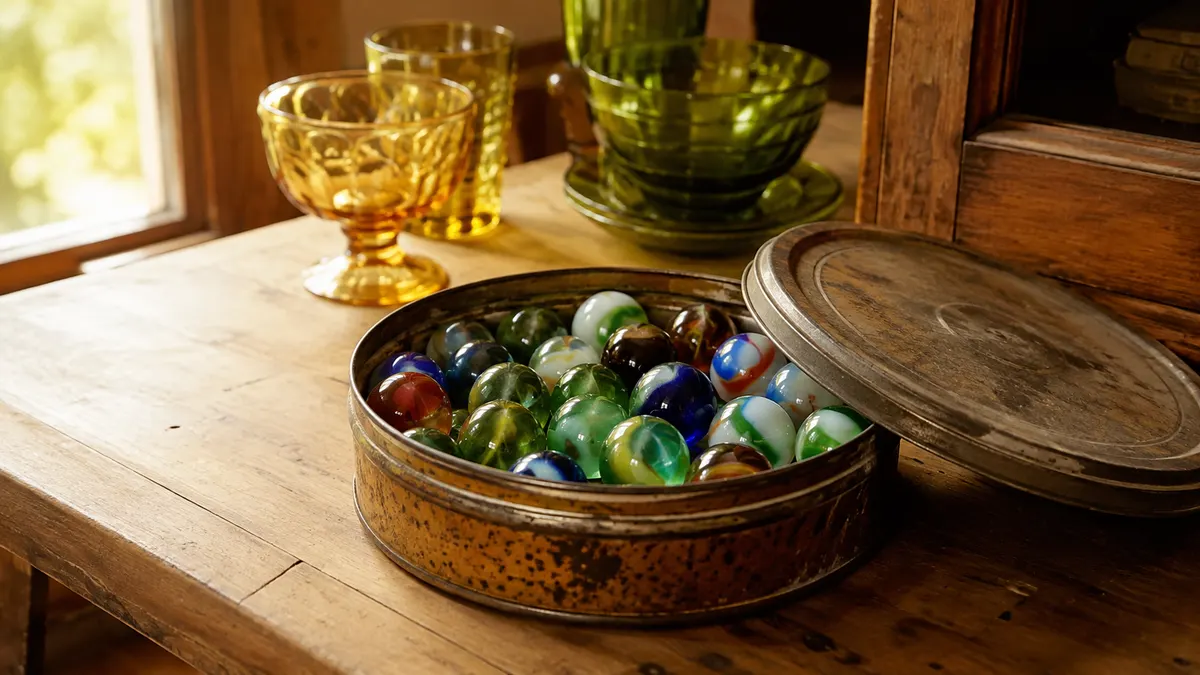
If you've ever priced a classic marble tin beside a loose bag of bulk glass, you know the first thing your hand does is reach for the bag. More marbles, less money, and the sales photo always makes the loose lot look like a jackpot. I buy and sell marbles out of a small shop with my wife Ruth, and it is the Toysmith Neato Classics tin I keep reaching for when I want to show a newcomer what a matched set of shooters should feel like. I've watched the same buyer weigh the tin against the bag dozens of times, then sit with a cup of coffee and sort through what actually showed up. The tin and the bag answer different questions, and once you see which question you're really asking, the choice stops being about the price tag. Most people who reach for the bag are not shopping for marbles yet, they are shopping for a bargain, and a bargain you never open is not a bargain at all.
The short version: the classic tin buys you a curated, matched assortment of shooters with their own storage built in, so it's the better starting point for someone who wants to keep them and look at them. The loose bag is the better buy for someone who wants raw volume to sort, trade, or shake loose the occasional gem, and who already has their own bins and patience. Both are fine. They serve different people, and pretending one is universally smarter is how you end up with a bag of forty mixed pieces you never opened. A bag of loose glass fits the collector building inventory to trade or play with, while the tin fits the one who wants a set that is finished the day it arrives. Neither is a better purchase in the abstract, and keeping that straight is the whole point of this comparison.
| Classic Marble Tin | Loose Bag of Bulk Marbles | |
|---|---|---|
| What you get | Classic tin (Toysmith 160) | Loose bag of bulk marbles |
| Cost per marble | Higher per-piece, lower floor | Lower per-piece, higher floor |
| Condition | Matched, usable pieces | Mixed, uneven quality |
| Storage | Tin box, ready to store | Heavy plastic bag, your job to sort |
| Best for | Start, keep, display, gift | Sort, trade, bulk play, fill gaps |
| Resale value | Strong if kept as a set | Depends entirely on the lot |
Where the Classic Tin Wins
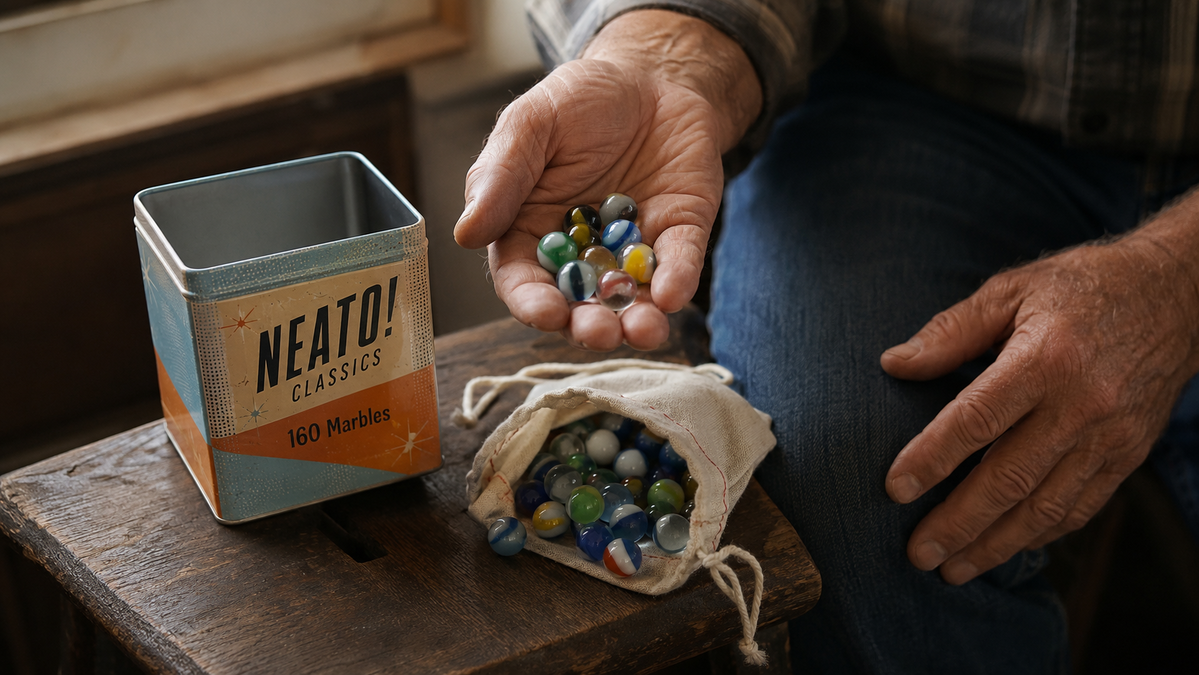
The tin's whole advantage is that someone already did the sorting for you. A bag of loose bulk is an unopened question. The Toysmith tin is the answer before you open it. Every marble in that 160-count box is a shooter or a small of a size and quality that holds together as a set, which matters enormously when the customer's first reaction is to spill a few out on the bench and roll them in their palm to check the weight and the finish. You can hand that box to a newcomer and know the third piece they pick up will feel as good as the first. That consistency builds trust, and trust is what decides whether a beginner sticks with the hobby at all. I would rather hand a newcomer one clean tin than a sack they have to dig through in front of me, because the digging is where a new collector loses heart. Once you have held that consistency, it is hard to go back to a mystery. I have watched a customer lift a tin off the counter and spend ten minutes running the marbles through their fingers without saying a word, and that quiet stretch is the exact moment a collection starts. The counter is the best salesperson a toy tin ever had, and the longer I leave one out, the more it earns its corner.
There is also the matter of the tin itself. In my daily work the difference between a piece of glass and a piece of glass you reach for is usually a few seconds of convenience, and a hard-sided tin that snaps shut beats a bag that has to be folded and tied and opened again every single time. I keep one full tin on the shop counter as a display and for people to handle, and one thing I notice is that nobody is shy about picking a marble out of an open tin. They hesitate the moment a loose bag is involved, because a bag reads as storage they will have to commit to. The tin says pick one up. That is what sells a collection in a shop, and it is the same thing that makes the tin a better gift for someone who does not collect yet. You are giving them a finished thing, not an assignment. A tin you can pass across the counter invites handling, and handling is how a small collection outgrows the drawer it was kept in. A bag can never do that same work, because for most people a bag stays tied shut on its shelf until the day they finally open it and lose heart. A tipped-open Toysmith tin on a counter invites the hand in a way a sack or a closed jar never can, and that frank, wordless invitation is worth more to a collector than the difference in the per-piece arithmetic.
Where a Loose Bag of Bulk Marbles Wins
I will not pretend the bag has no side of its own. If you already own bins and dividers and a lifetime of patience, a loose bag of bulk glass is the cheaper way to build a working inventory. You sort it once, keep the nice pieces, trade the workable ones, and the occasional gem that surfaces pays for the whole experiment. I have pulled perfectly good early glass out of bulk lots that would have cost five times as much bought individually. That is the honest draw of the bag, and I would be lying through my teeth if I said I did not still buy them myself for the hunt. Ruth and I buy loose lots at estate sales and split them out by hand every season. It is how most serious collections grow after the first hundred pieces, and no one should pretend the tin replaces that. There is real craft in working a bulk lot, and collectors who have learned it are not going to trade that pleasure for a ready made set. I understand that completely, because sorting is where I learned to read glass myself, and I would not ask anyone who enjoys it to give it up.
The bag also wins when the marbles are headed for actual play rather than a shelf. Kids, a game of shooters on the floor, marbles in a craft project, any use where pieces are going to get lost or banged around, that is exactly where a bulk bag belongs and where you should never put a curated tin. Using a matched set that way would be wasting its one real asset, which is that it holds together. And there is a budget side I respect: if the plan is simply to have a generous handful of glass in the house without any collecting intent, the bag is the honest purchase and the tin would be money spent on quality nobody in that house is going to notice. Match the money to the intent, and you rarely overpay. So the bag is not the plain inferior choice. It is the right tool for a specific kind of collector with the bins and the appetite already in place. Know which kind you are, and the per-piece arithmetic stops being the deciding factor altogether. For someone with the bins and the taste already set, a loose lot keeps giving for years, but the day a gift or a fresh start is the goal, I reach for the matched Toysmith tin again without a second thought.
Starting out, or keeping a matched set? The classic tin spares the sorting
If your intention is to keep a tidy, displayable set from the first day, the Toysmith 160-count tin is the one that arrives already sorted, matched, and ready to open. Check today's price and see the full box before you decide.
Amazon Check Today's Price on Amazon →
Who Should Buy Which
Buy the tin if you are starting a collection, if you want a set you can display or gift without doing a minute of sorting, or if you are replacing one classic set and want the whole thing to stay together. Buy the loose bag if you already have the bins, the patience, and the appetite for sorting, or if the marbles are headed for play and craft projects where pieces will get lost. The deciding question is simple, and it is not about the price per marble at all. It is whether you want a finished set or raw material. If you want a finished set, the tin returns its cost in the first weekend you can put the whole thing on a shelf and call it done. If you want raw material, a bag and a Saturday afternoon is the cheaper path to the same first handful. Either answer is legitimate, as long as you know which one you are actually buying for before the parcel arrives. Sit with that question before you order from inventory rather than intent. That mistake, buying to fill a box before you know what kind of collector you are, is the most common way a new one wastes the first handful. Answer the honest version of it and the right purchase mostly picks itself. The honest verdict from a bench where I have watched both choices play out for decades is that most beginners are better served by a matched, countable set than by guessing at a sack, which is a fine and gentle way to learn to lose heart.
The decision matters most when you are carrying your good pieces rather than your warehouse stock. In the years I have sold at shows I have watched marble on marble do the damage no one sees until the table lights come on. A loose stack in any bag trades chips across the whole lot; a hard-sided tin with a snug lid keeps every piece where you put it, so a two-hour drive does not turn a common into a broken common. The weight is a trade worth making once you have packed a bag that slides off the car seat and lands buckle first on a prize piece.
That is not to say you should leave the soft bag at home. If you buy in bulk by the pound there is nothing wrong with a cloth sack that packs flat and holds a hundred spares. But the shop pieces, the ones you would reach for to show a customer or to trade for a better example, want the tin. Fill it with a little cushioning if the box is larger than the lot, and keep the lid closed when it is not in your hand. Fifteen minutes of attention on the way out the door costs nothing and saves the pieces you actually care about.
A matched set you can open and display tonight
If the bag's sorting sounds like more work than you signed up for, the classic tin is the one that arrives finished. See today's price and a look at the full 160-count assortment before you decide how to spend your weekend.
Amazon Check Today's Price on Amazon →