

Most of the reviews you'll read for a 12-pack of clear acrylic easel stands tell you the same three things: they're clear, they're cheap, and they make a shelf look like a museum. All of that is true, and none of it is the part you actually need to know. What nobody says up front is that the real work of these stands is sizing, and sizing is where almost everyone gets it wrong. I've had a LRANFOW 12-pack on the bench in my shop in central Ohio since spring, running marbles and small glass across them, and the honest truth is that I use maybe eight of the twelve, and only for one size of piece.
I'm not going to tell you these are the best thing since felt-lined drawers, because they're not. They are a genuinely useful little tool for a narrow job, and the whole review below is about finding that narrow job and not stretching it. If you display one or two marbles at a time, or you're angling for a single trophy piece on a table, read on, because this one's for you. If you're here hoping to put your whole collection out in one go, I want to save you the ordering mistake I made before the box even arrived.
The Quick Verdict
The stand itself is fine and clear. The set is let down by its own sizing, which fits a narrow range of marbles well and leaves the rest teetering.
Amazon Check Today's Price →A clear stand is only as good as the marble you put on it
If you've got a few pieces worth showing off one at a time, a 12-pack of acrylic easels will get them up off the shelf and into the light for very little. Start with the sizing guide below before you order.
Amazon Check Today's Price on Amazon →How I've Used It
My wife Ruth and I run a small shop out of our home in Ohio, buying and selling vintage marbles and glassware. That means I'm not displaying a showpiece for the sake of it most days. I'm evaluating chips under a loupe, comparing two similar pieces, or showing a customer what a particular marble looks like in the light. The acrylic easels went to work in all three of those jobs, and that's exactly the kind of use they're built for.
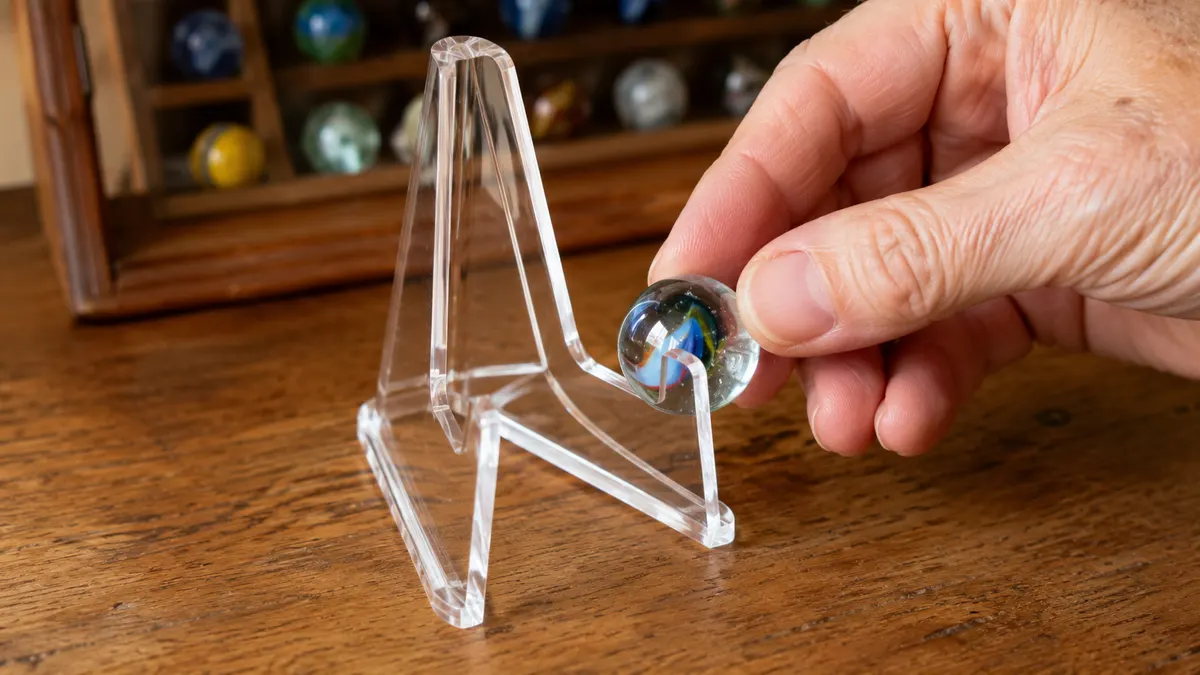
The pack arrives as twelve separate stands in three sizes, four of each. Each stand is a flat lucite sort of shape with a little lip, and you set your piece in that lip so it leans back slightly instead of sitting flat. Assembly is nothing. There's no snapping parts together and no clips. The stands just are, and you take each one out of its thin plastic sleeve and start using it. Took me about a minute to unpack all twelve and get a feel for the three heights.
I keep a couple on my bench daily for grading, a couple more near the register for showing a customer a find, and the rest stay in the drawer. That split, more than anything else, is the honest summary: this is a set you use a few of at a time, in different places, not a uniform grid you deploy all twelve of at once.
Truthfully, the first afternoon felt more like sorting beads than setting up a display. Twelve stands, three heights, no labels, and a tray of marbles of every size you can imagine. I spent a pleasant hour holding each stand up to each marble and learning, by eye, which of the four in its size group each one belonged to. Nobody mentions that step because nobody sells you the sorting, but it is where you build the sense for which stand a piece wants, and that sense is half the tool.
The Sizing Problem Nobody Warns You About
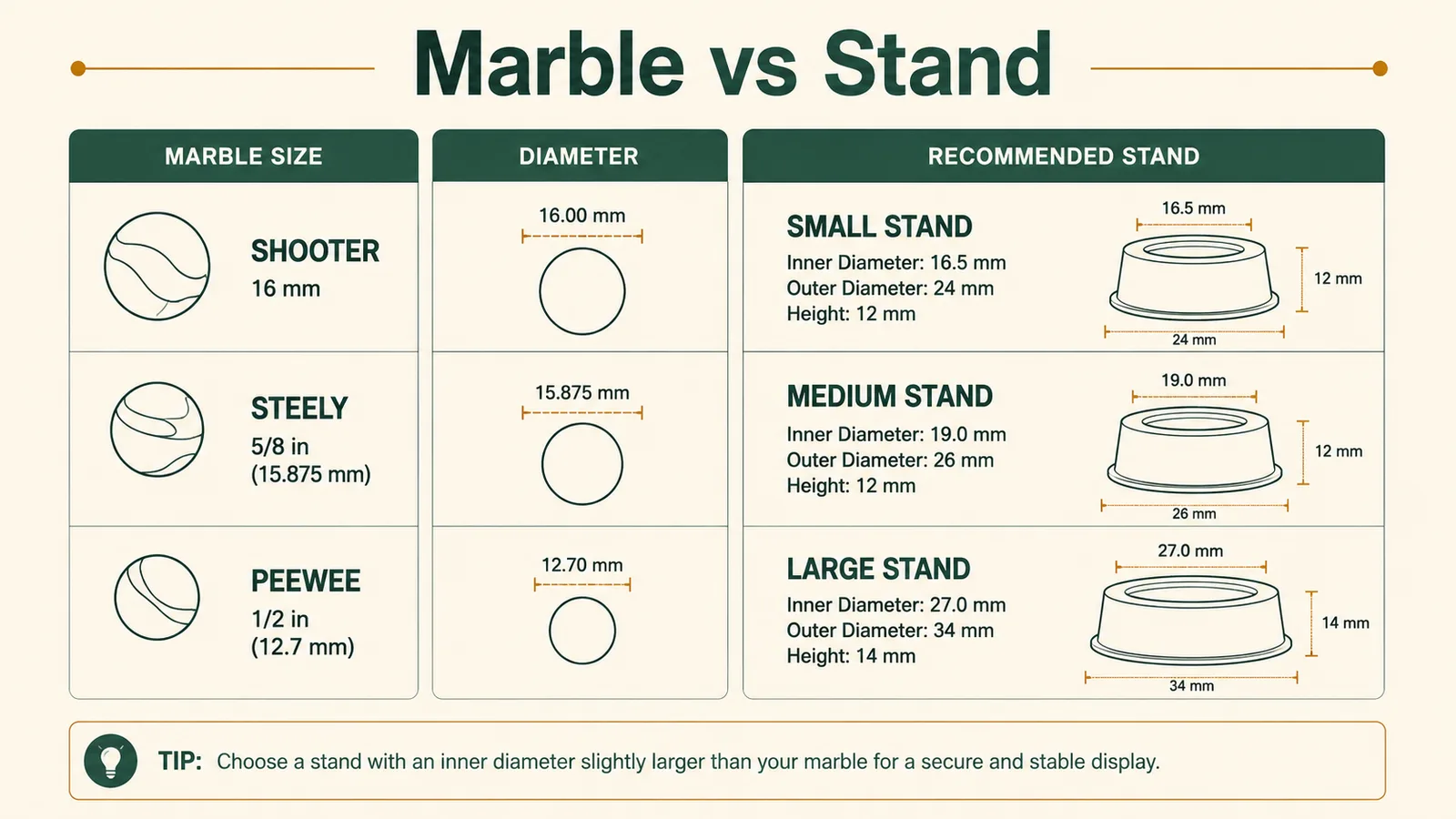
Here's the part I want you to actually read. These stands come in three sizes, and each one cups a specific range of marble. The smallest is for peewees and little clearies, around the size of a fingernail. The middle is the sweet spot, sized for a standard marble you'd shake out of a game or a trade lot, about three quarters of an inch. The largest is for shooters and big glass, around an inch or a little more.
That range sounds generous until you line up your actual collection. The trouble is that a marble is round, and a round thing in an open lip either sits down into it or rocks on top of it. If the piece is smaller than the groove, it drops to the bottom and you barely see it, which defeats the whole point of lifting it up. If it's bigger than the groove, it sits high and wobbles, and one nudge of the shelf sends it rolling. There is a narrow band where each stand is actually happy, and that band is smaller than you think.
I made the classic mistake on my first order: I measured my favorite shooter, an inch and a quarter, and bought a stand that looked about right in the product photos. When the pack arrived, that big piece was too heavy for the largest stand and just sat there looking nervous. The stand was built for a standard shooter, not a fat one. My advice, loud and clear: bring a caliper or at least a ruler to your own collection before you order, and buy the size that matches the actual diameter of the pieces you want to show.
A simple test fixes most of this. Set the marble in the groove of one of my LRANFOW stands and give it a small knock with your fingertip. If the piece rocks and wants to roll out, it is too big for that stand. If it sinks flush and you can tilt the stand over and the marble still holds, you have the right match. I run this on every piece before it earns a permanent spot, and it takes about three seconds a marble.
I bought my first pack for my favorite shooter and it wouldn't stay put. The stand was built for a standard shooter, and my one-and-a-quarter-inch piece was just too heavy for it. Match the size to the marble, not the marble to the pretty photo.
Stability and the Overloaded Shelf
On a solid, level surface with the right size matched, these stands are steady enough. The base is flat and wide enough relative to the lip that a normal thump on the shelf doesn't topple a properly seated marble. I've had a clearie sitting on my bench for months without it walking anywhere, and that's after plenty of morning sweeping and the occasional dropped box of something else landing nearby.
But they are not furniture, and they are not built for a crowd. The single biggest caution I can give anyone is about overloading the shelf. Each stand wants a little room around it, partly so you can read the piece and partly so a neighboring stand can't knock into it. Pack twelve of them edge to edge on one shelf and three things happen: you can't see the bottom of the marbles, one wobble travels down the whole row, and a piece can tip off the far end without you touching it. That crowded-corner shot in the photos always looks full and beautiful, and in real life it's the most dangerous way to load them.
The second stability note is the surface itself. These stands like a stable, non-slip table or shelf. On a polished or slightly angled surface they will slowly skate. If I put one on the glass top of a display cabinet, I set a little felt or wax under it first. That's a two-second habit and it turns a frustrating sliding stand into a reliable one.
And one more habit for anyone near a table edge. The tallest stands, the ones for shooters, set a marble up high enough that its center of gravity sits above the lip more than you would guess. Set those on the LRANFOW largest easels a little back from the front of the shelf, not dead center over the edge, and they will not walk off when you brush by. A couple of inches of insurance beats picking a good marble up off the floor.
And the honest limit: these are not for anything with real mass. A thick cut glass paperweight, a heavy vase, or a big agate slice will simply be too heavy and tip the stand forward. That's not a defect, it's the design declaring its own range. I use the big acrylic stands in my shop for glass and crystal finds, and I use these little easels only for marbles and very small glass. They are not interchangeable and it's better to know that now.
What the Clear Plastic Does to the Light
A marble is half about the glass and half about the light moving through it. That's the whole reason to lift a piece off a flat shelf in the first place. These stands do that well when you place them near a window or under a lamp, because the clear lucite lets the light come through from underneath and behind instead of just bouncing off the top.
The catch, and this is worth saying plainly, is that clear acrylic under bright light leaves fingerprints and shows dust in a week. If you display long term, you'll be wiping these down more often than you'd like, and a smudged stand makes the marble look duller than it would on nothing at all. On the bench where I'm moving pieces all day it's not a bother. As permanent display furniture it's a small, steady chore.
There's also a little reflection. Clear acrylic is not invisible, no matter what the marketing photos imply. In direct light you'll see a thin edge or a slight glare at the base of the piece. It's minor, and it disappears after a few days of looking at it, but if you were expecting these to vanish completely, recalibrate. They're meant to get out of the way, not to disappear.
Worth adding that the best light for these is a single soft source from one side, a lamp or a window that is not straight behind you. That way each clear easel throws one thin edge of reflection and the marble reads as lit from within rather than washed out. Two competing light sources, a lamp and a window facing each other, make the acrylic pick up two glares and the piece looks busy. One source, still air, and a clean LRANFOW stand is all it takes.
What I Liked
- Clear lucite that lets light move through the marble from behind
- Three sizes cover peewees, standard marbles, and small shooters
- No assembly, no clips, just unpack and set the piece in the lip
- Steady enough on a level surface with the right size matched
- Cheap enough to buy a pack and use a few at a time in different spots
- Light enough to move around the bench or into a display window easily
Where It Falls Short
- Sizing is the whole game, and the useful range of each stand is narrower than you'd guess
- Big shooters and heavy glass simply won't stay seated
- Pack all twelve edge to edge and one nudge travels the whole row
- Picks up fingerprints and dust, and needs regular wiping
- Not invisible in direct light, with a thin glare at the base
- Only four of each size per pack, so matching a full collection takes multiple orders
Alternatives I Considered
I didn't stop at the acrylic easels, and you shouldn't either if your plan is bigger than a few showpieces. For a whole collection, a glass-fronted display cabinet keeps the dust and the light off your pieces and holds far more without the wobble risk of a crowded shelf. For storage and sorting, a divided organizer box puts the bulk safely away so only the few best pieces earn a stand at all.
Against those, the little easel's job is narrow but real: it's the fastest way to lift a single piece into the light for grading, for showing, or for a quiet spot on a table. It is not storage, and it is not protection in any serious sense. It is a presentation tool, and it works when you treat it like one.
One more alternative I tested before committing to these, a wooden display block with a shallow drilled socket, holds a marble just as steady and looks a touch warmer on a walnut shelf. The trade is that it hides the underside of the piece and it is one size per block, so a mixed collection needs a rack of them. The clear easel shows the whole marble and one pack covers three sizes, which is why it earns the place on my bench. If your shelves are bare wood and you like the tall-cabinet look, a wooden block has its case; for the light and the range, the acrylic wins for me.

Who This Is For
These stands earn their keep for three kinds of collectors. First, the person who has one or two trophy marbles and wants them up in the light instead of in a box; a couple of these on the mantel is all you need. Second, anyone grading or comparing pieces regularly, where a stand on the bench keeps both hands free and the marble stable under a loupe. Third, the small dealer, because for showing a customer a find at the register or in a window, a clear easel is hard to beat.
Who Should Skip It
Skip these if your plan is to display your whole collection at once, because that's a shelf of cabinets, not a row of easels. Skip them if your best pieces are heavy, whether that's a fat shooter, a solid glass find, or an agate you'd like to sit down in something. And skip them if you want a permanent, low-maintenance display, because you'll be wiping acrylic more than you'll enjoy looking at it. For those jobs, match the size first with a cabinet or a stable riser and let the little easels go back to their proper lane.
Order the size that matches your actual marbles
If a few choice pieces are what you want in the light, a 12-pack of clear acrylic easel stands gets the job done for very little. Measure your best marbles first, then let the three sizes do the lifting.
Amazon Check Today's Price on Amazon →